
Send statements and see who is overdue
Once a month, make a statement for every account that owes or had activity, look them over, then email or print them. Aging shows who is behind and by how long.
In this chapter
Make the month's statements
Included on every plan except Static Website and Online Store.
The Statements button on Charge accounts opens the list of each month's statements, newest first.
- Statement
- One charge account's activity and amount due up to a date, sent to the customer once a month.
- Period ending
- The last day a statement covers. The next statements start the day after it.
- Remittance stub
- The bottom part of a statement, which the customer sends back with a check. It says who to make the check out to.
Making statements builds one for every charge account that owes something or had activity since its last statement. Only an account with a balance of exactly zero and no activity gets none, so an account holding a credit gets one every month. Making them sends nothing to customers.
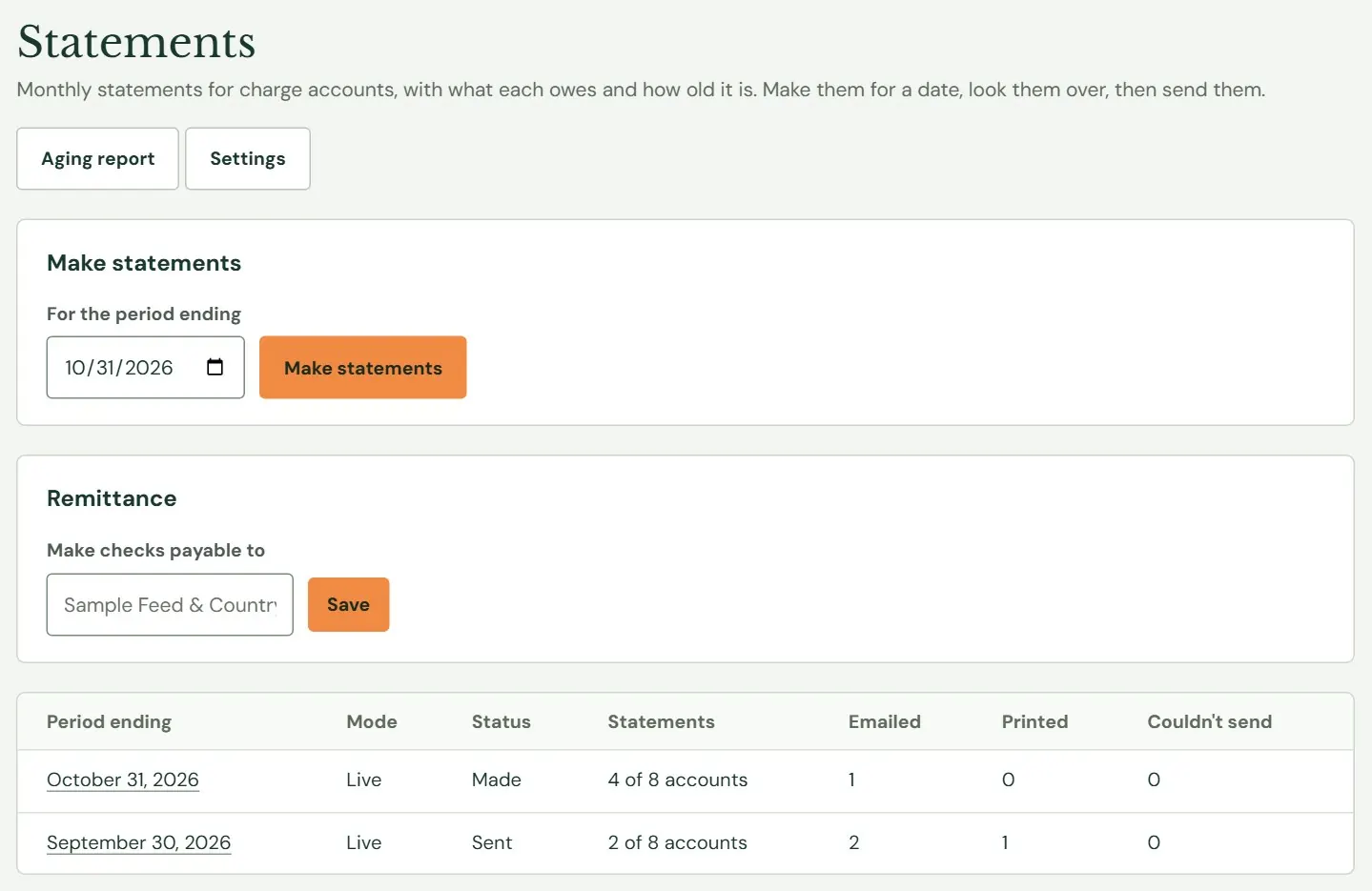
- 1For the period ending: check the last day the statements cover.
- 2Make statements builds them. Nothing is sent.
- 3Make checks payable to: the name on every remittance stub.
- 4Status: read where each month's statements stand.
If the store has finance charges or late fees turned on, making the statements adds them to every account past due by more than the days the store set. They go on when the statements are made, before anything is sent, once for each statement period. Statements made for another date mid-month start a new period and are charged again (Turn on a finance charge, in Chapter 14).
- Go to Customers, then Charge accounts, and press Statements.
- Check the date under For the period ending. It starts at your store's most recent closing day, which is the last day of the month unless Dirt Road has set another day for your store. The latest date it takes is today.
- Press Make statements. The message reads Making the statements for and the date, then Look them over, then send them. The month's own page opens and fills in as the statements are made.
Statements go in date order, each month starting the day after the last one ended. An earlier date is refused with Statements already go up to the last date and Choose a later date. The same date is refused with Statements for that date are already made. While the last statements are still being made, or after they stopped, Roadside asks you to wait or to make them again first (Look the statements over, then send or print them, in Chapter 13).
It worked when the month's row reads Made and the month's page has no Couldn't be made table. A month that missed accounts also reads Made, and its page names how many. The Statements column gives how many were made, out of the charge accounts Roadside checked. The other columns count what happened next:
| Status | What it means |
|---|---|
| Waiting | Roadside has the request and starts on it shortly. |
| Making | The statements are being made. |
| Made | Every statement that could be made is ready to look over, send and print. |
| Sending | Someone pressed Send and the emails are on their way. |
| Sent | No email is still waiting to go. |
| Stopped | Making them stopped partway. Open the month and press Make again. |
A status followed by held for review and a number has emails that need a person to check them. Emailed, Printed and Couldn't send count the statements emailed, put in the print file, and not sent.
Who checks are made out to
The Remittance card is the Store owner's. Type the name in Make checks payable to, up to 120 characters, and press Save. Left empty, the stub uses the store's name. Statements made after you save carry it. Statements already made keep the name they were made with.
To find the customer behind an account, start from the customer's own account (Find a customer by name, phone or contact, in Chapter 30 of Core Roadside).
Look the statements over, then send or print them
Included on every plan except Static Website and Online Store.
Press a date under Period ending on Statements to open that month. The page is headed Statements for and the date. The line under it gives the status, how many statements were made from how many charge accounts, and Due by, the date every statement on it is due.
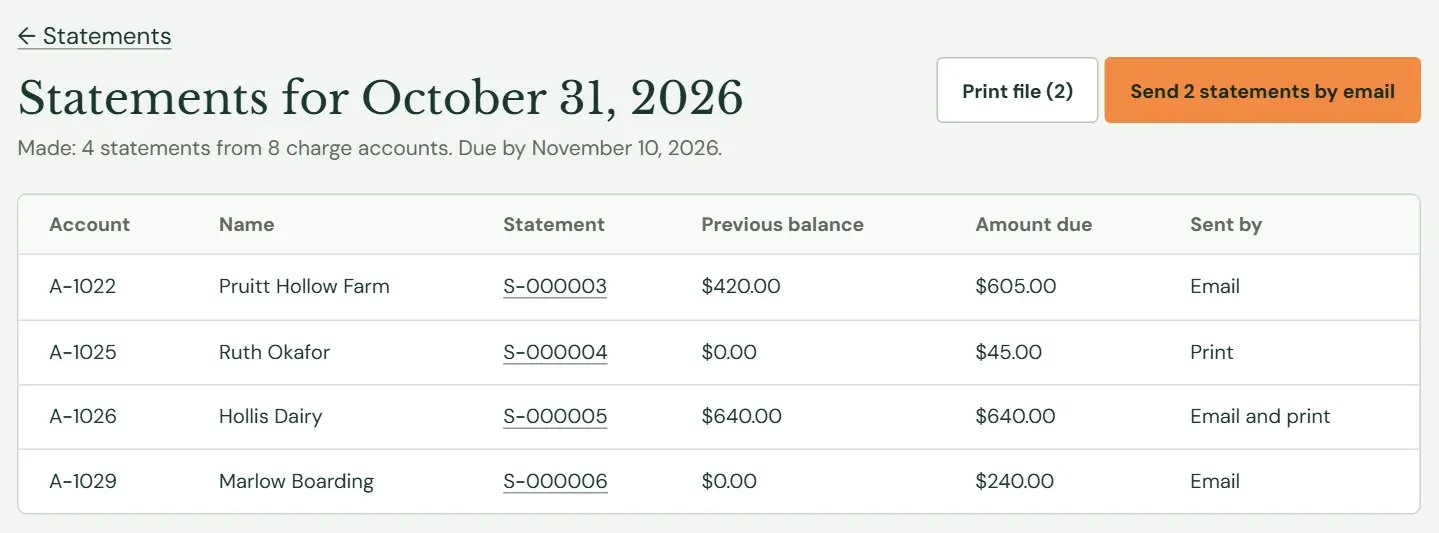
- 1Due by: the date printed on every statement in this month.
- 2Amount due: check each account's total before anything goes out.
- 3Sent by: how each account takes its statement.
- 4Print file downloads one PDF of the statements that go by print.
- 5Send emails every statement that goes by email.
Each statement goes the way its charge account says, shown under Sent by: Email, Print or Email and print. That choice belongs to the charge account (Change a limit, the terms or how statements go, in Chapter 11). An email goes to the account's address for statements, or to the customer account's email when that is empty.
Send emails every statement on the page whose account takes statements by email and has an address for them, each with its statement attached as a PDF, under the subject Statement for the month from your store's name. An email cannot be called back. An account set to email with no address is not counted on the button and gets nothing: add the address on its charge account first (Change a limit, the terms or how statements go, in Chapter 11).
- Read down Previous balance and Amount due. Open two or three statements and check them (Open, preview or email one statement, in Chapter 13).
- If a table headed Couldn't be made shows, read its Why column. Fix what it names, then press Make again. The message reads Making the missing statements again.
- Press Print file. The number on the button is how many statements go by print. Roadside downloads one PDF, named
Statements-and the period's date, with those statements in account-number order, and counts each as printed. Print it and mail them. - Press Send, the button that names how many statements go by email, once you are happy with them. The message reads Sending, the number, and statements by email.
The buttons show once the statements are made. Send shows while any email statement with an address is left to send, and Print file while any account takes its statement by print. It worked when the status reads Sending, then Sent, and Emailed on Statements counts the emails. Pressing Send again sends only what is not on its way already, and when nothing is left it says Nothing new to send.
Emails that did not go
A table headed with a number and emails not sent lists emails that stopped before they left, so nothing reached the customer. Its Why column gives the cause. Fix it, then press Send again.
A table headed with a number and emails held for review lists emails that may have gone. Roadside never sends one of these again on its own. Open the statement from the table, read its Delivery history, and check with the customer before you send another copy from the statement's page.
When Make again is refused
Make again shows when making stopped, or when some statements could not be made. While an email from the month is still going out, the page shows These statements are still being sent. Try again when sending has finished. in its place. Once a later month's statements exist, the button does not show, and the missed activity appears on that account's next statement.
Open, preview or email one statement
Included on every plan except Static Website and Online Store.
Press a statement's number in the Statement column of a month's page. The page is headed Statement and its number, and the line under it names the customer, the account and the dates it covers. PDF downloads it.
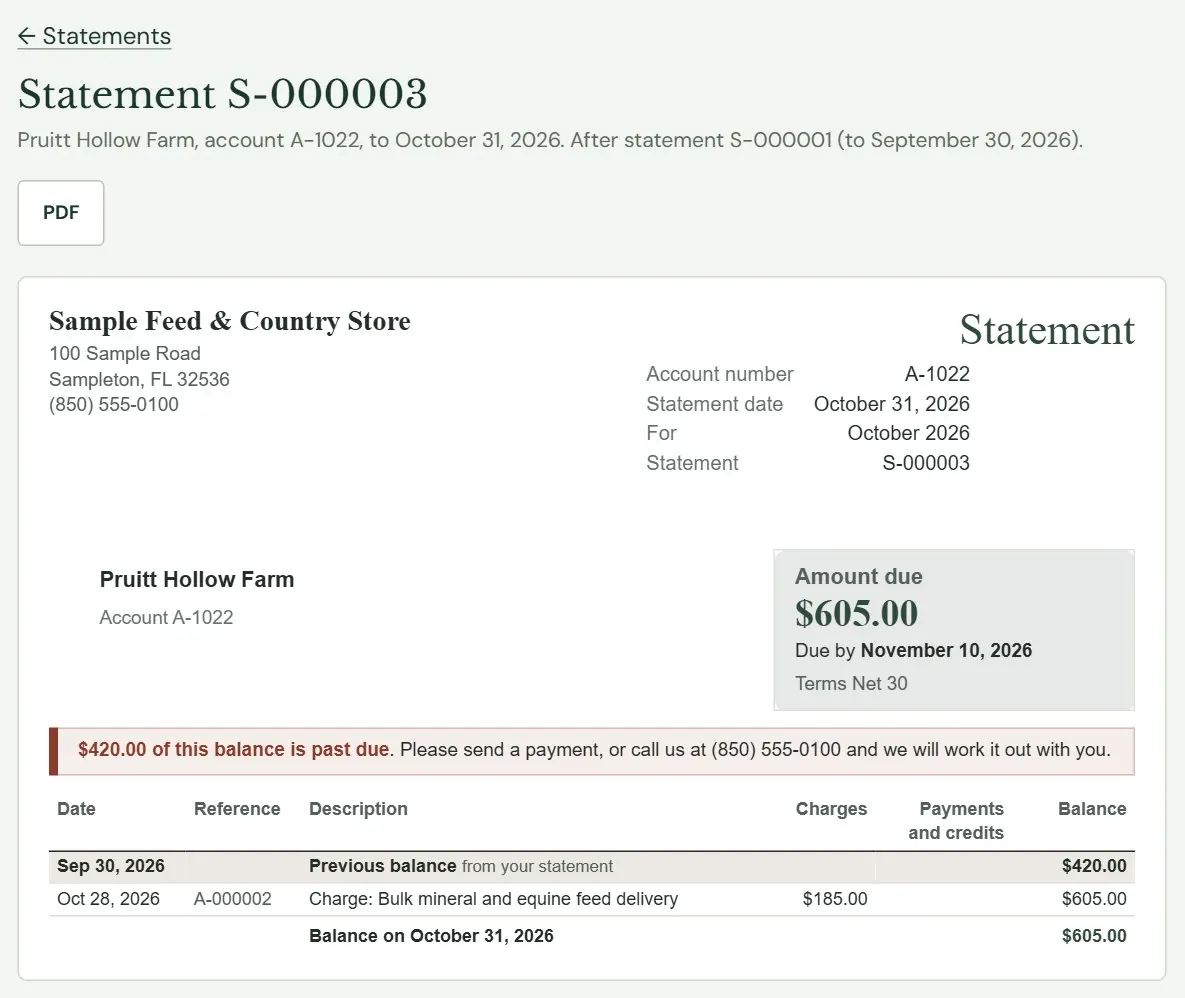
- 1Amount due: what the customer owes on the statement date.
- 2Due by: the date the amount is due.
- 3Charges: each purchase or fee added in the period.
- 4Payments and credits: what came off the balance.
- 5PDF downloads the statement as the customer gets it.
The statement carries your store's details, Account number, Statement date, Amount due (or Credit balance when the store owes the customer), Due by and the account's terms. The activity table has Date, Reference, Description, Charges, Payments and credits and Balance. Under it, the balance is split by how old it is, and the stub at the foot reads Please return this part with your payment. A customer with store credit sees Store credit, the amount, and is yours to spend. It is not part of the amount due.
A statement keeps what it showed on the day it was made. Changing the account afterwards, its address or its terms, changes the next statement, not this one.
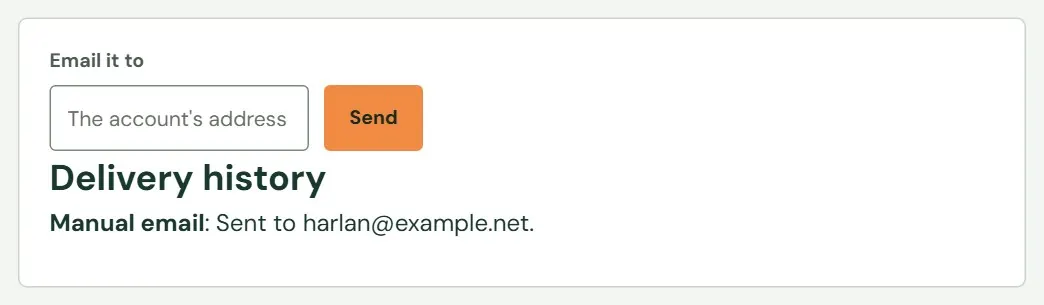
- 1Email it to: type an address, or leave it empty for the account's own.
- 2Send emails this statement.
- 3Delivery history: check whether each copy went.
- Type an address in Email it to, or leave it empty. Empty sends it to the account's address for statements.
- Press Send. The statement goes by email with its PDF attached, to the address you typed or the account's own, so check the address first. The message reads Sending the statement. With no address to use, it reads The account has no email address for statements. and nothing is sent.
- Read Delivery history. Each email has its own line, such as Manual email: Sent and the address. A copy in the print file shows as Printed.
A line reading Queued or Handoff underway is still going. One reading Handoff needs review adds This email may have been sent. Check the delivery history before sending another copy. It will not be resent automatically. One reading Failed before handoff adds Nothing was sent. Fix the cause, then send it again. While a copy is still on its way, Send refuses a second one.
A preview from Aging
An account number on Aging opens that account's statement up to the Aging date, headed Statement preview with the line Preview: not saved and not sent. A preview saves nothing, adds no finance charge or late fee, and has no Send card. Its PDF button downloads it. A date earlier than the account's latest statement is refused with This account's statements already go up to and that date.
On Whole Store the account owner can download the statement from your website (Know what the account owner sees on the website, in Chapter 13).
See who is overdue
Included on every plan except Static Website and Online Store.
Aging lists what each charge account owed on a date, split by how long it has been owed. Open it with the Aging button on Charge accounts, or the Aging report button on Statements.
- Aging
- What customers owe, sorted by how long it has been owed. Store owners also call it A/R aging.
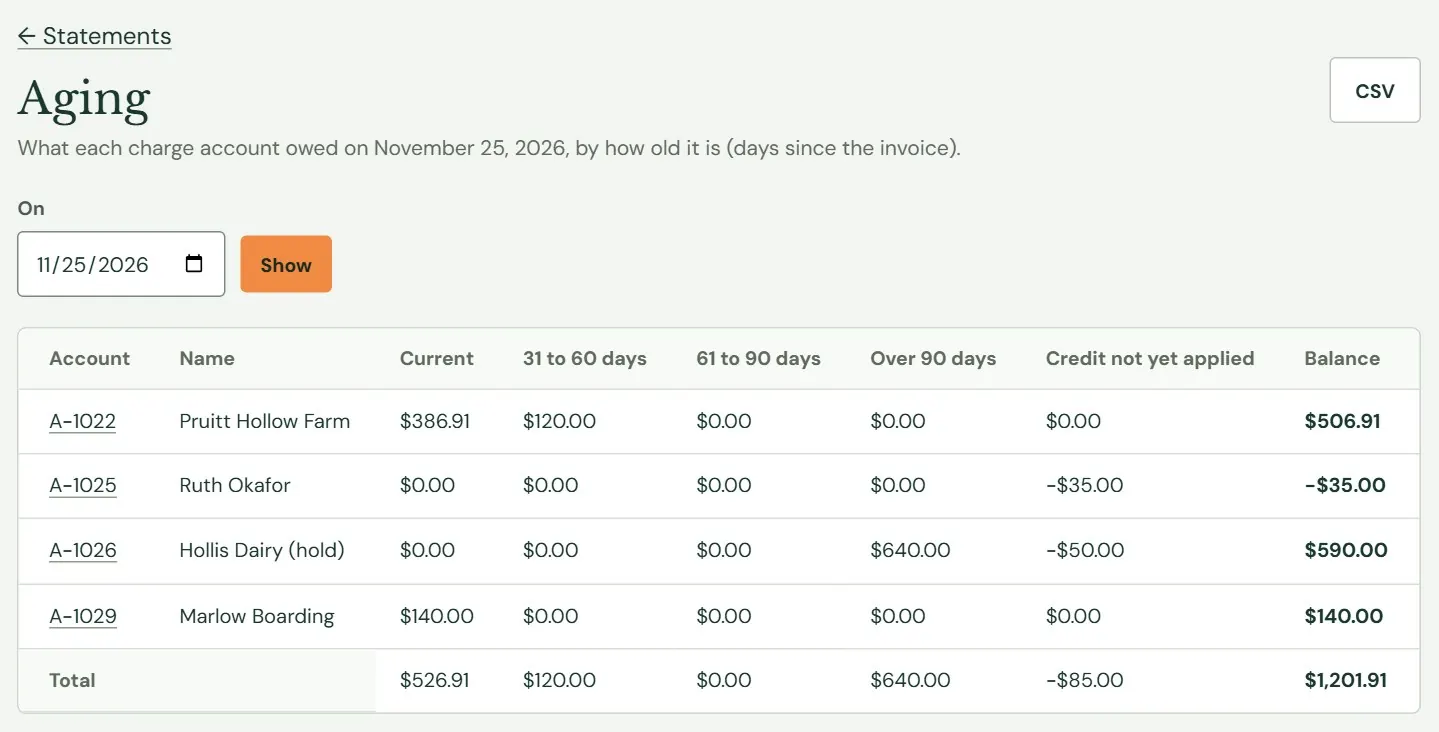
- 1On: choose the date to see, today at the latest.
- 231 to 60 days: amounts from invoices one to two months old.
- 3Over 90 days: the oldest amounts, to chase first.
- 4Balance: what the account owes in all.
- 5CSV downloads the table for a spreadsheet.
- Press Aging on Charge accounts, or Aging report on Statements. The page opens on today's date.
- To see another day, choose it in On and press Show. The line under the heading names the date and how the columns count.
- Read across each account. The columns are Current, 31 to 60 days, 61 to 90 days and Over 90 days, counted from each invoice's date, then Credit not yet applied and Balance. An account that is on hold or closed shows that after its name. The Total row adds up every column.
- Press an account number to open its statement preview for that date.
- Press CSV for the same table as a file named
aging-and the date, with each account's Status and Purpose added.
Some stores have their aging set to count from the due date, and the line under the heading then says days past due. The columns read Not yet due, 1 to 30 days past due, 31 to 60 days past due, 61 to 90 days past due and Over 90 days past due.
It worked when an account's Balance for today's date matches the balance on its Charge account card. When no account has a balance or a credit, the table reads Nothing owed on any charge account.
Read only people can download the CSV too. It holds every account's balance, so keep the file private.
Show the account owner their statements online
Included on the Whole Store plan.
The customer portal lets the owner of a charge account sign in on your website and read the account's statements and invoices. Roadside calls it Customer portal. On the website the customer sees it as Account documents and orders, on their Your account page.
- Customer portal
- The part of the store's website where a charge account's owner reads its statements and invoices.
The Store owner sets it up once, from All of Roadside with Set it up (Set up a tool the store already has, in Chapter 3 of Core Roadside). Switching it off later works the same way as for any tool (Switch off a tool the store set up, in Chapter 3 of Core Roadside). After that, the Customer portal screen under Website shows whether customers can read their documents. It changes nothing itself. Store owners and Managers open it. Staff and Read only do not.
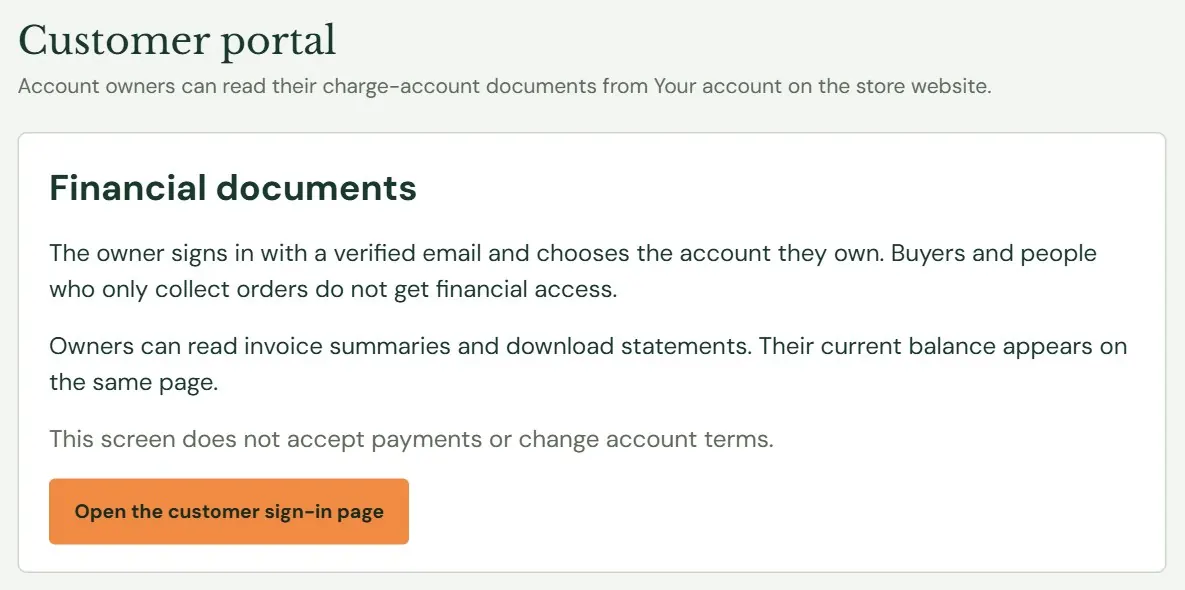
- 1Customer portal: the screen's name in Roadside.
- 2Financial documents: read who can see the account's papers.
- 3Open the customer sign-in page: see the page customers use.
- Go to Website, then Customer portal.
- Check for a warning at the top. With none, account owners can read their documents.
- Press Open the customer sign-in page. Your website's account page opens in a new tab, where customers sign in.
The Financial documents card says who gets in: The owner signs in with a verified email and chooses the account they own. Buyers and people who only collect orders do not get financial access. An authorized buyer can still charge to the account but cannot read its statements. The owner reads invoice summaries, downloads statements and sees the current balance. The portal takes no payments and changes no terms, so the customer still pays at the counter or by check.
A warning that begins Financial access is unavailable until Online ordering and Charge accounts are enabled means one of the two is off for your store. Write to support@dirtroadsoftware.com.
A customer signs in on your website the same way they do to follow an order (Help a customer find or repeat an order, in Chapter 23 of Core Roadside).
Know what the account owner sees on the website
Included on the Whole Store plan.
Once the owner signs in on your website and chooses their account, the Your account page shows a section headed Account documents and orders, with the line View financial documents or build a cart from a past order. Contact the store about payments. These are the words on the Sample store's website. Your website's design may word the headings differently.
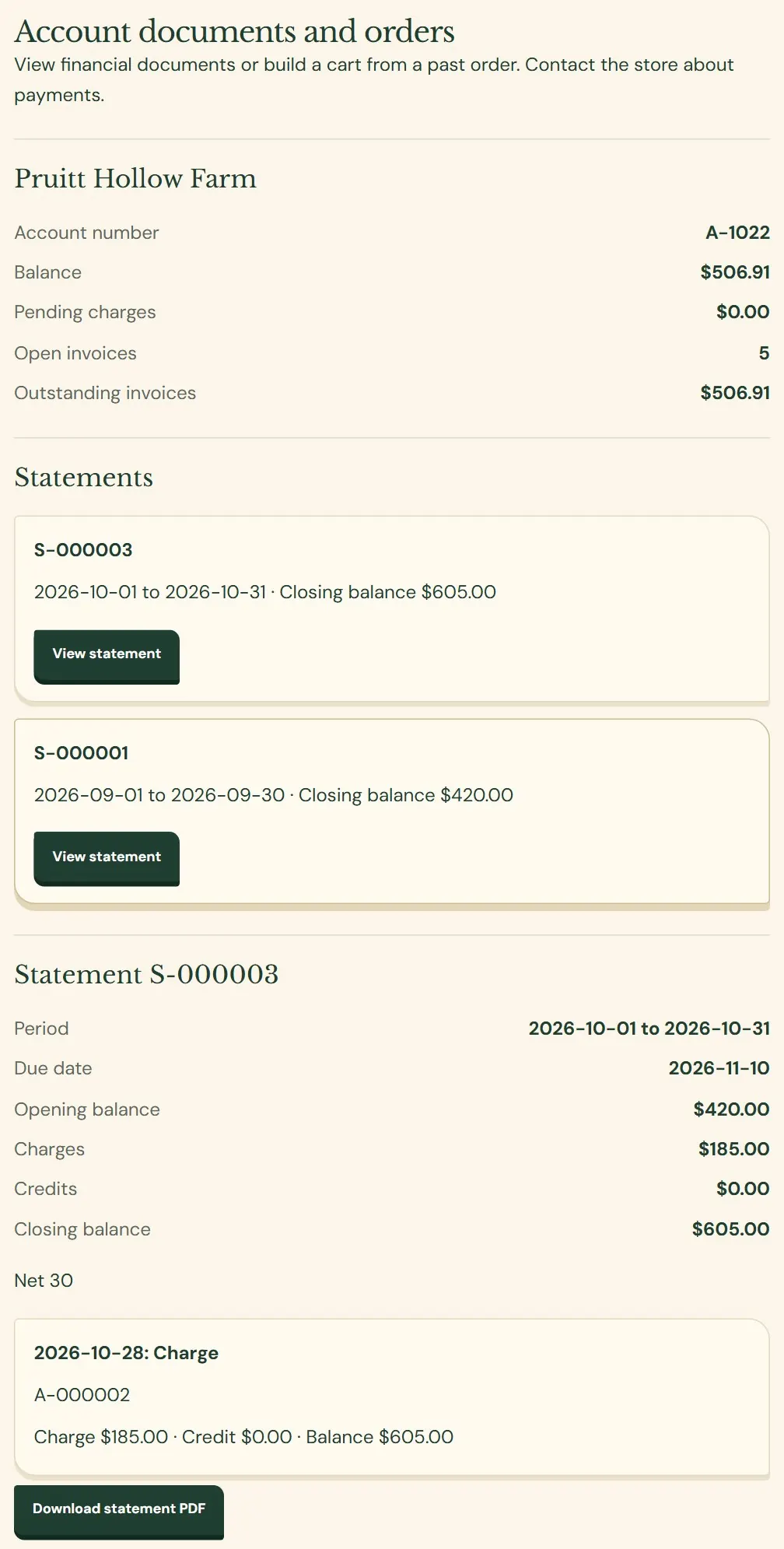
- 1Balance: what the account owes today.
- 2Statements: the account's statements, newest first.
- 3View statement opens one statement on the page.
- 4Download statement PDF saves the statement as a file.
At the top are Account number, Balance, Pending charges, Open invoices and Outstanding invoices. Below come two lists, Statements and Invoices, with View statement and View invoice on each line. A statement opens with its period, opening and closing balance and activity, and the button Download statement PDF. The PDF has the same amounts, dates and balances as the statement Roadside makes, with each line described in plain words such as Charged or Payment and never your staff's notes. An invoice shows Invoice date, Due date, Amount, Applied, Remaining, Status and Purchase order.
Under Order again, the owner picks a past order to see which items are available today, then presses Add selected items to cart. The page says This adds a cart draft. It does not place an order.
When a customer sees nothing
The section stays hidden for anyone on the account who is not its signed-in owner, and for an owner whose account has no charge account. If the documents fail to load for another reason, the page reads Financial documents could not be loaded. Refresh your account to try again.
It worked when the owner's Balance matches the balance on the customer's Charge account card in Roadside.
Something here does not match your screen? Write to support@dirtroadsoftware.com with the name of the screen, what you pressed and what you expected. A picture of the screen helps.